Car Towed From a Parking Lot? Your Rights
Coming back to an empty parking space is a specific kind of awful. A tow from private property — an apartment complex, a shopping centre lot, a business after hours — works differently from a police-ordered tow, and California gives you more rights in that situation than most people realise. Knowing them is worth real money, because the meter starts the moment your car arrives at the yard.
First: find out where it went
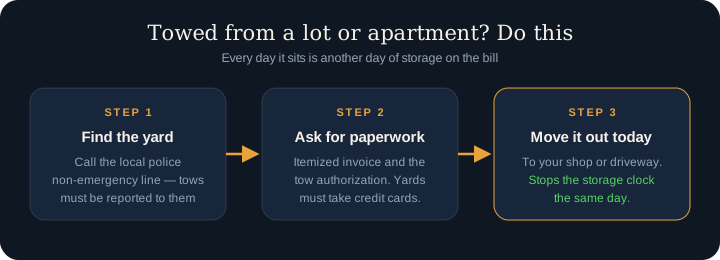
Before assuming theft, call the non-emergency line of the local police department — Fairfield PD, Suisun City PD, Vacaville PD, or the Solano County Sheriff depending on where you parked. California requires a towing company that takes a vehicle from private property to report it to local law enforcement promptly, generally within an hour. That report is how you find your car.
Have your plate, and the address you parked at. If the police have no record of it, that is worth noting — an unreported tow is itself a problem, and it is also the point at which theft becomes a real possibility.
If you catch them before the truck leaves
This one is worth knowing because it comes up constantly. Under California law, if you return to your vehicle before the tow truck has left the property, the driver is required to release it to you. They can charge you, but only a reduced amount — not more than half the normal towing fee.
The catch is “before it has left the property.” Once the truck is on the public road, that window has closed and you are recovering it from the yard. If you come running out and your car is on the deck but the truck is still in the lot, say clearly that you want the vehicle released and that you understand there is a fee. Do not physically interfere with the truck or the driver — that turns a billing dispute into something much worse.
What the yard has to do
A few things are not optional, and asking for them signals you know the rules:
- Accept credit cards. Storage yards in California are required to take card payment. “Cash only” is not a legitimate condition of getting your car back.
- Give you an itemized invoice. Not a total scrawled on a page — a breakdown of the tow, the storage per day, and any gate or release fee.
- Show you the authorization. You are entitled to ask who ordered the tow and on what basis. Private-property tows generally require either posted signage meeting specific requirements or a signed authorization from the property owner for that specific vehicle.
- Let you retrieve personal property. Your belongings inside the car are yours regardless of whether you have paid the tow bill yet.
If a yard refuses any of these, write down what was said and when, and get the name of the person who said it. That record is what makes a complaint or a small claims case work.
Was the signage actually there?
Private-property towing in California generally depends on the lot being properly posted — signs at each entrance, visible, stating that unauthorised vehicles will be towed and giving the towing company’s information. The specific requirements are detailed, and a lot that is not properly posted usually cannot tow you without the owner authorising that specific vehicle.
Go back and photograph the entrances. If there is no sign, or it went up recently, or it is hidden behind a hedge, you may have a case for getting your money back — the statute allows vehicle owners to recover damages for improper tows, and in some circumstances more than what they paid. Rules do get amended, so confirm current requirements before you rely on them, and talk to a lawyer or your local small claims advisor if the amount justifies it.
The part that actually costs you money
Here is the thing most people get wrong: they spend three days arguing about whether the tow was fair, while the storage clock runs the entire time.
Storage is charged daily. A dispute that takes a week can easily cost more in storage than the original tow did. The strategy that saves money is almost always to get the car out first and argue afterward — paying under protest does not waive your right to dispute the charge, and it stops the bill from growing while you do.
Pay, retrieve, keep every receipt and photograph, and pursue the refund from a position where the meter is no longer running.
Getting it out of the yard
If the car is drivable and you have the release, you can drive it away. Two situations where you cannot:
It is not drivable. A car towed with a flat, a dead battery, or existing damage still has that problem sitting in the yard.
Your licence or registration is a problem. Some yards will not release a vehicle to someone who cannot legally drive it off the lot.
In both cases you need a tow from the yard to your shop or your driveway — and that second short tow is very often cheaper than another two or three days of storage while you sort out the alternative. Once your release is cleared, we can collect it and deliver it wherever you want it.
Avoiding the next one
Most private-property tows in Fairfield and Vacaville come down to the same few things: parking in a numbered space that belongs to someone else, staying in a customer lot after the business closed, guest parking without the permit the complex requires, or blocking a dumpster or fire lane. If you are visiting someone at an apartment complex, five minutes spent finding out what guest parking actually requires is cheaper than any of this.
Need a vehicle moved out of a yard in Solano County? Solano Towing dispatch answers 24/7 at (707) 356-ROAD, and we can collect it as soon as your release is in hand.