Flat Tire on I-80: Change It or Call?
A flat tire is the one roadside problem most drivers assume they can handle. In a driveway, usually yes. On the shoulder of I-80 through Fairfield at four in the afternoon, with traffic going past your back at freeway speed, it is a different question, and the right answer is often not the one your pride suggests.
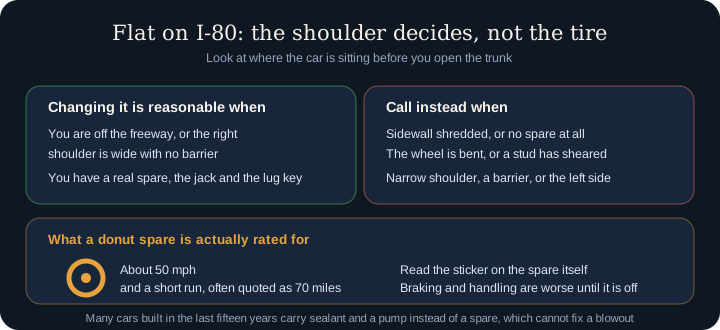
First decide where you are, not what is wrong
Before you open the trunk, look at where the car is sitting.
The right shoulder on most of I-80 through Solano County is wide enough to work on, but not everywhere. Through the Cordelia Junction, on the bridges, in the construction zones and anywhere the shoulder narrows against a barrier, there is no safe place to kneel. The left shoulder is worse in every case: you would be working on the driver’s side with traffic passing within a few feet, and getting out of the car puts you in the fast lane.
If the shoulder is narrow, the answer is simple. Stay in the car with your seatbelt on, hazards flashing, and call. A stopped car is a visible object that drivers steer around. A person crouched beside a wheel is not.
Driving on a flat is sometimes the right trade
Nobody likes this advice, but it is worth saying plainly: a tire costs less than a person.
If you are a quarter mile from the next exit and the shoulder is unsafe, easing along at very low speed with the hazards on to get off the freeway is usually the better choice. You will ruin the tire, which is already ruined, and you may damage the wheel. On I-80 through Fairfield and Vacaville the exits are close together, and getting into a lot off Green Valley Road or Air Base Parkway turns a dangerous job into a routine one.
What you should not do is keep driving at speed on a flat. The tire comes apart, the rim digs in, and you lose steering control.
Your spare may not be what you think
Open the trunk before you need it. Three things surprise people.
Many new cars have no spare at all. For about fifteen years, manufacturers have been shipping an inflator kit and a bottle of sealant instead, to save weight. That kit works on a small puncture in the tread. It does nothing for a sidewall cut, a blowout, or anything that came apart on the freeway, which is most of what happens at 70 mph.
A donut is a temporary tire with real limits. The sticker on the spare itself gives them, and they are typically around 50 mph and a short distance, often quoted as about 70 miles. That is enough to get you to a tire shop. It is not enough to drive to Sacramento and back, and the handling and braking of the car are noticeably worse while it is on.
The locking lug nut key goes missing. Alloy wheels often have one lug per wheel that needs a special key, usually tossed in the glovebox or with the jack. Without it, nobody is getting that wheel off at the roadside, including us. If you have never checked, check.
When it has to be a tow
Call rather than change it if any of these are true:
- No spare, and the damage is more than a small puncture. Sealant will not fix a shredded sidewall.
- Two tires are down. Debris in a lane often gets both on one side, and you only have one spare at best.
- The wheel itself is damaged. A cracked or badly bent rim will not seal, even with a good tire on it.
- The lug nuts will not come off, or a stud has sheared.
- The shoulder is too narrow to work on, which covers most of the bridges and the junction.
- You are not confident with a jack. A car dropping off a jack on soft or sloped ground is a serious injury, and roadside gravel is exactly that kind of ground.
A flatbed solves all of these the same way, and on a car with one wheel out of action it is the method that does not drag a damaged corner.
What to tell dispatch
- Direction of travel and the last exit you passed. Not the next one you can see. Crossing the median is not an option, so a truck sent the wrong way loses ten minutes minimum.
- Which wheel and what the tire looks like. A puncture that is going down slowly is a different job from a blowout.
- Whether you have a usable spare and the lug key.
- How much shoulder you have. If you are against a barrier, say so, because it changes how the truck sets up and whether a second unit is needed to block.
Prevention, briefly
Most freeway flats start weeks earlier. Tires lose pressure as the weather cools, and an underinflated tire runs hot, which is what turns a slow leak into a blowout on a warm afternoon climb toward the grade. Check pressures monthly when the tires are cold, and look at the sidewalls while you are down there for cuts, bulges or cracking. If your car has a tire pressure warning light, treat it as a real warning rather than a seasonal nuisance.
Sitting on the shoulder right now? Solano Towing dispatch answers 24/7 at (707) 356-ROAD, with a firm price before the truck rolls, anywhere from Vallejo up to Vacaville. Here is what else roadside assistance covers on the spot.