Locked Keys in the Car? What to Know
Nobody plans this one. You set the keys on the seat while you load groceries at the Solano Town Center, or you leave them in the cupholder at a gas station on North Texas Street, and the door locks itself. It is one of the most common calls we take, it usually ends well, and the next twenty minutes go better if you know what actually helps.
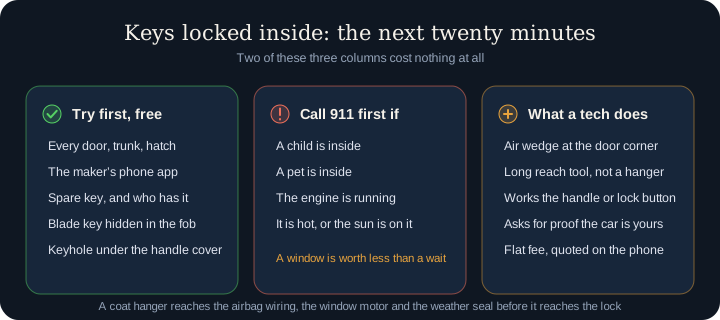
Check the easy things first
Before anyone drives out to you, spend two minutes on the free options.
Walk the whole car. The driver’s door locking does not always mean the rest did. Try every door, the tailgate or trunk, and on a hatchback the rear glass if it opens separately.
Check your phone. If your car is from roughly the last decade and you ever set up the manufacturer’s app, there is a good chance it can unlock the doors from your phone. Most brands offer this, and it costs nothing. It is worth the ninety seconds it takes to log in.
Think about the spare. Not where it should be, but where it actually is. A partner ten minutes away with the spare key beats any service call.
One situation that is not a lockout call
If a child or a pet is locked inside, call 911 first. Do not wait for a tow truck.
A closed car on a warm Fairfield afternoon heats up far faster than people expect, and the inside of a car parked in the sun can reach dangerous temperatures in minutes, not hours. The fire department will open it, and if the fastest way in is a window, that is the right trade and nobody will second guess it. The same goes for a car locked with the engine running in an enclosed garage.
Tell the dispatcher exactly who is inside and how long they have been there. That changes how the call is prioritized.
Why the coat hanger is a bad idea
Everyone has seen it done in a film, and on a car from 1985 it often worked. Modern doors are a different object.
Inside the door skin of a current car are the window regulator and its motor, the lock actuator and its linkage, wiring for the mirror, speakers and switches, and on many vehicles the side curtain airbag and its sensor. A wire fished blindly past the weather seal catches all of it. The repair bill for a torn regulator or a damaged airbag circuit is many times the cost of the lockout, and it is not covered by anything.
The weather seal itself is the other casualty. Once it is creased or pulled loose, the door whistles at freeway speed and leaks in the rain.
Breaking glass is also worse than it sounds. The small fixed quarter window is not cheap, side glass showers the interior with fragments that stay in the seat rails for years, and on many cars the window is laminated and simply does not break the way people expect.
What a lockout actually involves
The tool kit is an air wedge and a long reach tool. The wedge goes into the top corner of the door frame and creates a gap of a few millimeters, wide enough to pass a coated rod through without touching the glass or the seal. From there the technician works the interior handle, the lock button, or on a keyless car the unlock switch on the door panel.
On most vehicles it takes a few minutes. Some take longer: deadlocking systems, frameless windows on coupes and convertibles, and a few European models need a different approach, and a good operator will tell you on the phone if yours is one of them.
Expect to be asked for proof the car is yours. A license that matches the registration, or a registration document in your name once the door is open, is normal and it protects you.
When a lockout will not fix it
Worth being straight about the cases where opening the door is not the answer:
- The key is lost, not locked inside. Getting the door open does not start the car. A modern key has to be cut and programmed to the vehicle, which is a locksmith or dealer job. What we can do is tow the car to wherever that work is happening.
- The key is locked in the trunk of a car with no pass-through and no trunk release inside the cabin.
- The key broke off in the lock or the ignition. Same answer: that is key work, not door work.
- The key fob battery died. Many fobs hide a mechanical blade key inside, and most cars have a hidden keyhole on the driver’s door, often behind a small cover on the handle. Your owner’s manual shows both. That one you can usually solve in the parking lot.
What to tell dispatch
Four things get the right person to you quickly:
- Year, make and model. This decides which tools come out of the truck.
- Exactly where you are. In a garage, name the level and the nearest stairwell. In a big lot, name the store or the row. “The Premium Outlets” is a very large area.
- Whether the engine is running and whether anyone is inside.
- Whether you can show the car is yours. If your wallet is also locked in the car, say so up front rather than at the end.
What it costs
A lockout is a flat call-out fee, quoted on the phone before anyone is dispatched, and it does not change at 2am. There is no mileage component the way there is on a tow, because nothing gets towed. If the car turns out to need key work rather than door work, you will be told that on the phone when you describe the problem, not after a truck has arrived.
Standing next to your own car right now? Solano Towing dispatch answers 24/7 at (707) 356-ROAD, covering Fairfield, Vallejo, Vacaville and the rest of Solano County. Here is more on how lockout service works.