Motorcycle Towing: How Your Bike Should Ride
A motorcycle is the vehicle most often damaged in transit, and almost never by the breakdown itself. It has no parking brake to hold it, nothing to strap over, and one badly chosen tie-down point can crack a fairing or bend a set of forks. If you ride around here — Highway 12 toward Rio Vista, the roads past Rockville, or just the daily I-80 slog — it is worth knowing what a correct load looks like before you are standing on a shoulder watching someone do it.
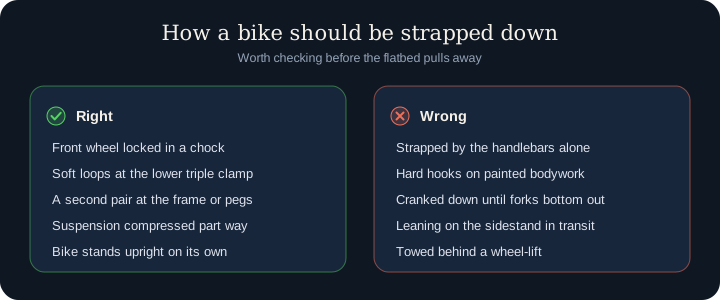
Flatbed, not a wheel-lift
A bike belongs on a flatbed with a wheel chock. Full stop. Towing a motorcycle behind a wheel-lift means it is being dragged on one wheel with nothing holding it upright except straps under tension the whole way — and every bump changes that tension.
The chock is what makes the difference. It captures the front wheel and holds the bike vertical on its own, so the straps are keeping it settled rather than holding it up. A bike that would stand on its own without the straps is a bike that will arrive the way it left.
Where the straps actually go
The front pair goes on soft loops around the lower triple clamp, or around the fork tubes above the axle on some bikes. Soft loops are fabric — they wrap the hard point and give the metal hook something to grab that is not your paintwork.
The common mistake is strapping by the handlebars. Bars are levers. Pulling down hard on them loads the steering head and fork seals in a direction they were never designed for, and on some bikes the bars will bend before anything else does.
A second pair goes at the frame, the pegs, or the swingarm to stop the back end walking sideways. Where exactly depends on the bike, which is why the operator should be looking at yours rather than working from habit.
Compressed, but not bottomed out
The forks should be compressed part of the way — enough to preload the straps so they cannot go slack over a bump, but not cranked down until the suspension is fully bottomed.
Fully compressed forks for an hour on I-80 is hard on the seals, and it removes the suspension travel that would otherwise absorb the road. A bike strapped solid to a deck takes every impact through its frame instead. Roughly a third to half of available travel is the working range most operators aim for.
Bikes that will not roll
A seized wheel, a dropped bike with a bent rotor, or a chain that has come off and locked the rear — none of these roll up a ramp. That is fine, but it changes the equipment: the operator needs skates, a winch, or extra hands.
Say so when you call. The difference between “my bike broke down” and “my bike went down and the rear wheel will not turn” decides what is on the truck when it arrives, and getting it wrong means waiting twice.
If your bike went down
Two things matter before it gets loaded.
Fluids. A bike on its side leaks fuel and oil. If it is still leaking, say so — it changes how the bike is handled and where it can be set down.
Do not straighten anything. The instinct is to bend a lever or a peg back into place. Leave it. If there is an insurance claim, the damage should be photographed as it happened, and a bent lever is cheap next to an argument with an adjuster about what was already broken.
Ask the operator to photograph the bike before it is loaded and after it is secured. Any operator worth using does this without being asked.
What to check before it pulls away
It takes fifteen seconds and it is entirely reasonable to ask:
- Is the front wheel actually seated in the chock?
- Are the front straps on soft loops, not hooked to paint or plastic?
- Is there a second pair holding the rear?
- Is the suspension compressed but not slammed?
- Would the bike stand up if the straps came off?
If the answer to the last one is no, it is not secured — it is suspended, and that is the arrangement that fails.
Trikes, trailers, and touring bikes
Full-dress touring bikes are heavier and taller than a standard chock expects, trikes will not fit a single-wheel chock at all, and small trailers need their own approach. All of them are movable, but all of them need the right deck and gear, so mention what you ride when you call rather than after the truck shows up.
What it costs
Motorcycle towing in Fairfield, Suisun City, and Vacaville is priced the same way as anything else we move: a hook fee plus a per-mile rate, quoted as one firm number before the truck is dispatched. It is not a premium service with a premium price — the flatbed and chock are simply the correct equipment.
Longer runs to a dealer or a specialist shop in Sacramento or the Bay Area are priced by distance, so have the destination ready when you call.
Down on the side of the road with a bike? Solano Towing dispatch answers 24/7 at (707) 356-ROAD, and every bike goes out on a flatbed with a chock.